Summarize with
The majority of flat roof repair projects in Seattle, WA stem from a broken seam, broken flashing or a blocked drain where water sits on the roof for days. If caught early, a roofer should be able to patch it up in a few hours and the insulation will not be soaked below.
Wait through a wet November and that same small opening can rot the roof deck. Our flat roof repair covers TPO, PVC and EPDM roofs on Seattle homes and small buildings. Below you’ll find what actually causes these leaks and what you can check yourself. You’ll also see the point where a pro should take over.
Key Takeaways
- The most common source of leaks is a seam, a flashing detail or a blocked drain.
- The water flows across the ceiling under the membrane, which means that the ceiling stain is not usually underneath the hole.
- Clearing drains is safe homeowner work. Cutting into the membrane is not.
- Small patches on a Seattle house usually need no permit.
- Call a roofer when the deck feels soft or the same spot leaks twice.
What Causes Flat Roof Leaks on Seattle Homes?
The main causes of flat roof leaks are standing water and tired seams and flashing that have pulled loose. In Seattle, all three get worse from October to March when the roof barely dries out. A flat roof isn’t truly flat. It’s built with a slight slope so water drifts toward a drain or scupper. Once Douglas fir needles or maple leaves block that path the water just sits there. Ponding that lasts more than 48 hours after rain is the clearest early warning you’ll get.
Seams come next. EPDM rubber is glued at the laps and that adhesive dries out with age. TPO seams are heat welded and hold well unless they were underheated when the roof went on. Flashing fails wherever something pokes through the membrane. Plumbing vents and skylight curbs and the base of a parapet wall are the usual suspects. The sealant at those spots cracks long before the membrane wears out.
Foot traffic from HVAC techs and punctures from falling branches round out the list. That is why a good flat roof repair Seattle, WA visit starts at the drains and not at the ceiling stain. For more warning signs read our post on common flat roof problems in Seattle.
| Tip 1: Walk the roof two days after a heavy rain. Any puddle still sitting there marks a drainage problem to fix before it shows up inside. |
Which Flat Roof Materials Fail First in Seattle’s Wet Climate?
Typically, older EPDM and torch down roofs leak first due to the need to rely on glue or heat to hold seams together, which deteriorates with age. TPO and PVC are more weather resistant and still fail at the corners and penetrations.
| Membrane | Where it shows up in Seattle | Common weak spot | Typical repair |
|---|---|---|---|
| TPO | Newer townhouse roof decks and additions | Underheated welds and flashing corners | Heat welded patch or cover strip |
| PVC | Roof decks and small commercial roofs | Shrinking sheets near edges | Hot air welded patch |
| EPDM | Older garage and porch roofs | Lap seams and pull at walls | Seam primer and new seam tape |
| Modified bitumen | Mid century homes and older garages | Blisters and a cracked cap sheet | Cut, dry, and re-adhere |
Always patch with the same membrane that’s already on the roof. An EPDM patch glued onto TPO won’t bond and tends to lift within a season. Age tells you the rest. A membrane past 20 years with leaks in several places is usually closer to replacement than flat roof repair.
Why Flat Roof Leaks Seattle WA Homeowners Find Indoors Start Somewhere Else
On a flat roof, water flows sideways beneath the roofing membrane before dripping through. The stain on your ceiling can sit 10 feet or more from the real opening. Seattle’s rain makes the hunt harder. NOAA’s 1991 to 2020 climate normals put Sea Tac Airport at about 39 inches of rain a year. Most of it lands between October and March. A slow leak can feed wet insulation for months without a single dry stretch.
The rigid foam board under most membranes holds water and loses much of its insulating value once it’s soaked. So flat roof leaks Seattle, WA owners notice in November often began as a small opening months earlier. A roofer finds the entry point with a moisture meter or an infrared scan before cutting anything.
A solid flat roof repair in Seattle, WA quote names where water gets in and not just where it comes out. If water is already dripping into a room see our guide to emergency roof tarping in Seattle.
What Permit and License Rules Apply to Flat Roof Repair Seattle WA Homeowners Book?
Most leak repairs on a house need no permit in Seattle. SDCI’s roof replacement affidavit says patching or replacing less than 500 square feet of roofing in any six months is exempt. Full roof replacement on a single family home, duplex or townhouse is also exempt as long as the insulation value stays the same or improves. Apartment buildings and commercial roofs are different.
The roof cover, sheathing or insulation must be replaced with a re-roof permit in place from the Seattle Department of Construction and Inspections. SDCI uses that permit to check energy code compliance and closes it with a signed affidavit instead of a site visit.
Licensing is simpler. Washington requires roofing contractors to register with the Department of Labor & Industries. Their registration number must appear in their ads and should be on your written bid. L&I’s free Verify tool shows whether their bond and insurance are active.
| Pro Tip: On any project over $6000 ask your roofer to post a performance bond. L&I suggests it because the bond covers the full value of the job if problems come up. |
How to Fix a Flat Roof Leak in Six Steps
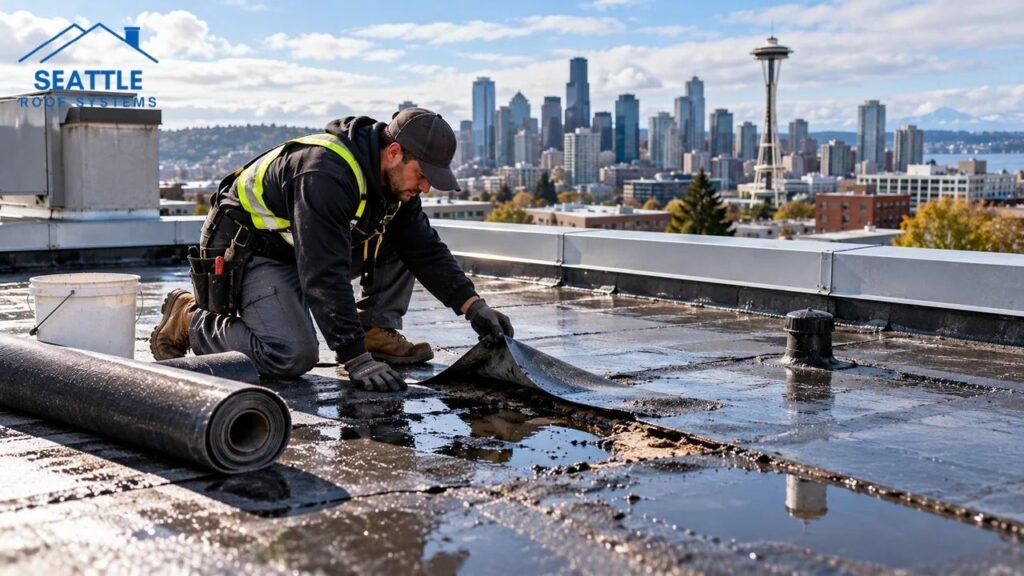
The first step in repairing a leaky flat roof is to determine the source of the leak. Then the area gets dried and patched with matching membrane.
- Clear every drain and scupper. Ponding from a blocked drain can look like a failed seam and send you chasing the wrong spot.
- Map the wet area. A moisture meter or infrared camera indicates the extent of water penetration into the membrane.
- Cut out wet insulation. A patch over soaked foam board traps water and blisters by spring.
- Clean and prime the repair zone. TPO gets membrane cleaner and EPDM gets its own primer so the new layer bonds.
- Patch at least 2 inches past the damage on every side. Heat weld TPO or PVC. Roll EPDM seam tape flat with no trapped air.
- Reseal the flashing and test after the next rain. A dry ceiling after a real storm is the only proof the repair worked.
| Bonus Tip: Book non urgent repairs for late summer. Welds and adhesives bond best on a warm dry deck and you beat the October rush. |
Mistakes That Ruin a Flat Roof Leak Repair
The biggest mistake is patching above the ceiling stain instead of the real opening. A close second is smearing roof cement over a seam and calling it done.
- Roof cement and caulk are stopgaps. They crack after one season of wet and dry cycles. They also make a proper flat roof leak repair harder because the roofer has to scrape them off first.
- Mixing products causes more failures. Asphalt based sealants can damage EPDM and TPO, so neither membrane should see them.
- Hard soled boots are another problem. A boot heel or a dropped tool can puncture an older membrane. Add walk pads where techs service the HVAC unit.
- Rolling a coating over a wet roof is the costliest error of all. Coatings only work on a dry and sound membrane.
| Tip 2: Take pictures of the leak on the date and of the weather conditions that day. Insurers and roofers both operate quicker with a clear record. |
When to Call a Roofer for a Flat Roof Leak
If the deck is soft, water gets into a room or the identical location drips again, call a roofer. Both of those require water that is already underneath the membrane that a do-it-yourself patch can’t access. The mere fact of knowing when you need a roofer and the roof is flat will save you the expense of getting it fixed twice.
- Soft or spongy decking. Wet wood under the membrane has to be cut out and replaced.
- Stains in more than one room. Water has spread across a wide band of insulation.
- A leak that returns after a patch. The source is somewhere else or the seam failure runs longer than it looks.
- Large damage on an aging roof. Spot repairs on a worn membrane can end up costing more than a planned replacement.
- Storm damage you plan to claim. A roofer’s written report carries more weight with an adjuster than phone photos.
Flat roof repair questions Seattle homeowners ask
These are the questions that come up once a homeowner spots a stain on the ceiling.
How much does it cost to fix a leak in a flat roof?
Fixing a leak in a flat roof usually costs between $300 and $ 1,200, and most homeowners pay around $800. The final price depends on whether the leak is a simple surface puncture or a larger structural problem. Our flat roof cost guide breaks down Seattle repair and replacement numbers.
Does insurance cover flat roof leaks?
Homeowners insurance covers a flat roof leak only when a sudden and accidental covered peril causes it. Examples include a severe storm, hail, high winds, a falling tree or fire.
What are the most common causes of flat roof leaks?
Flat roofs leak mainly because water moves slowly across them. That slow drainage gives water more time to pool and stress the materials and find weak entry points.
How much does it cost to have a flat roof repair?
The national average cost to repair a flat roof ranges from $300 to $1100 and most homeowners pay roughly $900 for standard repairs. Per square foot expect $2.50 to $10.00 depending on location, material and the type of damage.
Are flat roofs more expensive to repair?
Not always upfront. Flat roof repairs often cost more over time because they need more maintenance and specialized labor than pitched roofs.
What is the 25% rule for roofing?
The 25% rule says that if more than 25% of a roof or roof section is repaired or replaced or recovered within 12 months then the whole roof or section must meet current building code. How it applies depends on your local code.
Can a flat roof be repaired?
Yes. A flat roof can be repaired when the damage is localized and the deck underneath is still structurally sound.
Conclusion
Regular inspections, clear drains, and timely seam repairs help keep Seattle’s flat roofs dry through the rainy season. If leaks return, the decking feels soft, or water reaches your ceiling, contact Seattle Roof Systems for professional flat roof repair in Seattle, WA services before the damage spreads.
Talk to a Flat Roof Crew in Seattle
Call Seattle Roof Systems at (425) 996-1386 or email zoom@seattleroofsystems.com to talk about your particular requirements. When you contact a company for flat roof repair in Seattle, WA, have a picture of the stain to ensure that the service crew arrives with the correct membrane. The team has 10 years of experience and is licensed by SEATTRS752DC in Washington.
Sources
- NOAA NCEI U.S. Climate Normals: https://www.ncei.noaa.gov/products/land-based-station/us-climate-normals
- Seattle SDCI Re-Roof Permit: https://seattle.gov/sdci/permits/permits-we-issue-%28a-z%29/re-roof-permit
- WA L&I Hire Smart Step by Step: https://lni.wa.gov/licensing-permits/contractors/hiring-a-contractor/hire-smart-step-by-step