Summarize with
Flat roofing Seattle, WA jobs live or die on drainage. Rain falls on roughly 150 days a year here, and a nearly level deck gets almost no help from gravity. Seattle does not require a permit for most roof replacements on one and two family homes and townhouses. Projects that do need review must meet the city’s roof replacement affidavit rules and that includes R 38 continuous insulation above the deck wherever existing sheathing or insulation is exposed.
Owners of a flat roof Seattle, WA house may have a small area, such as a porch cover, garage deck or a backyard addition. Small areas can be complicated. The experts in low slope roof services consider even a 150 square foot area of deck as a full waterproofing system. This guide explains how local weather changes material choice and which defects show up first. It also walks through installation and repair and seasonal upkeep.
Every flat roofing Seattle, WA decision below comes back to one question: where does the water go? Before any ladder goes up check the roofer’s state registration. Washington’s legislature raised the required contractor bond to fifteen thousand dollars for specialty contractors and thirty thousand for general contractors on registrations from July 1, 2024 onward.
What Makes Flat Roofing Different From a Sloped Roof
The difference between flat roofing in Seattle, WA and sloped roofing is the use of sealed membranes, design of drains and overflow systems to handle rainwater and prevent leaks and standing water.
| Feature | Flat or Low Slope Roof | Sloped Roof |
|---|---|---|
| Water Drainage | Drains through designed outlets and drainage systems rather than relying primarily on pitch. | Sheds water quickly through its slope. |
| Water Retention | Water can remain near seams for hours, increasing the importance of proper sealing. | Water typically runs off the roof quickly. |
| Roofing Protection | The membrane must remain sealed to protect the roof deck from standing water. | The sloped roofing surface directs water downward. |
| Common Risks | Seam failures, clogged drains, standing water, and drainage problems. | Risks associated with damaged roofing materials and inadequate drainage. |
| Seattle Roof Design | Older homes may have flat sections over entrances and sunrooms, sometimes with a single drain and no backup. | Roof pitch helps direct rainwater toward the eaves and gutters. |
| Drainage Safety | Parapet roofs usually need overflow scuppers to help prevent water accumulation if the primary drain becomes clogged. | Water generally flows toward the roof edges when the pitch and drainage system are properly designed. |
How Does Seattle Low Slope Roof Weather Shape Material Choice
Low slope roof weather in Seattle swings between a long wet season and a short dry summer. A membrane has to manage both. The wet side does far more damage. Steady drizzle runs from October through May.
Heat spikes matter too. Sea Tac recorded 108 degrees on June 28, 2021, and a black membrane soaks up that kind of heat. The table below shows how the four common systems compare.
| Feature | EPDM | TPO | PVC | Modified bitumen |
|---|---|---|---|---|
| Seam method | Tape or adhesive | Heat welded | Heat welded | Torch or cold applied |
| Heat handling | Black and absorbs heat | White and reflects heat | White and reflects heat | Granule cap shields the layer |
| Typical service life | 20 to 25 years | 20 to 30 years | 20 to 30 years | 15 to 25 years |
| Weak point | Seam tape at edges | Punctures from foot traffic | Higher material price | Torch work needs a fire watch |
Most Seattle homes land on TPO or EPDM. Pick by the detail work at walls and drains rather than the brochure. A 60 mil sheet with sloppy flashing fails sooner than a thinner sheet detailed well.
Which Flat Roof Problems Seattle WA Homeowners See Most?
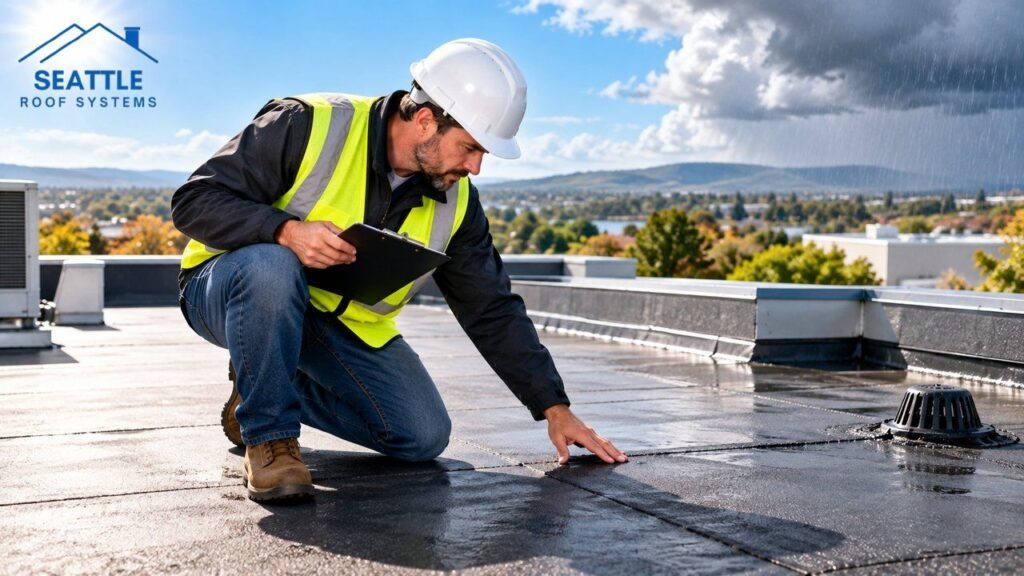
Ponding and clogged drains are the main reasons for leaks on low slope roofs. Water standing for more than 48 hours after rain is the warning sign. The roofers consider it to be a failure in the drainage system and not the normal wear and tear of the roof.
- It’s typically done with Douglas fir needles or bigleaf maple leaves. During one storm, they fill in scuppers. Moss on dark color decks under evergreen trees will retain even more water against the membrane.
- Old patches are a problem as well. Applying roofing cement to a split appears to be a security however it splits in a season. The traffic on roof decks also causes more damage to a membrane than rain does.
| Tip: Take a picture of each of the drains after the first major October rain. A dated photo makes slow drainage easy to spot the following year. |
What Steps Does Flat Roof Installation Seattle WA Follow?
For flat roof installation in Seattle, WA, follow these six steps to ensure proper permits, a sound roof deck, effective drainage, secure membrane seams and durable flashing.
- Verify if the permit is valid with the Seattle Department of Construction and Inspections. Changes of shape are not covered, but replacement of the shape is normally not subject to replacement.
- Remove old roofing shingles to the deck. Test the sheathing for soft spots that have been caused by years of wet winters.
- Replace rotting plywood, and allow the deck to dry. Wet conditions cause the rotting of new work from the bottom.
- Use tapered insulation to direct the water to drains. If possible, target a minimum of 1/4” per foot of fall.
- Install the membrane and weld or bond all seams. Test each seam before testing the next one.
- Flash walls and curbs, drains and penetrations. Use coated edge metal (steel or aluminum) rather than copper or zinc that run off can have detrimental effects on local creeks.
| Bonus Tip: Schedule the job during June, July, or August, or September. Membranes bond better to a dry deck and crews avoid middle of the job soakings. |
When Is Flat Roof Repair Seattle WA Enough and When Is Replacement Smarter?
Repairs if damage is confined to the surface and the insulation below is dry. If the leaks continue to return or moisture is detected in the insulation through the moisture scan, replacement is the option. A patch over wet insulation does not solve the problem.
Before you make a decision, count the patches. If 3 repairs are required in 5 years, the field is typically fatigued. That’s why Seattle exempts patching less than 500 square feet in any six months from a permit, keeping fixes quick.
| Pro Tip: Request the roofer to cut one of the small test squares and demonstrate the amount of insulation underneath. If it is dry board, it means that repairs are feasible. If the board is damp or crumbling, it needs to be replaced. |
How Does Flat Roof Maintenance Seattle WA Change Through the Year?
Flush out the drains each fall and check the seams each spring. Check after each significant wind event. Most of those failures can be detected before the ceiling gets stained in those visits.
- October: Clean up and get rid of needles and leaves before the rains start.
- After windstorms: November to January, look for metal that is lifted from the edges.
- Spring: Clean off moss and algae. Avoid copper and zinc moss treatments – runoff to Puget Sound creeks.
- August: Walk the roof in dry conditions, identifying any rising seam.
| Tip: Use a plastic leaf rake and soft broom. A membrane is cut into by metal tools. |
Does a Flat Roof Seattle WA Home Need a Permit?
Most single family replacement is exempt but structural roofs and commercial/multi-family roofing require review. Additionally, the city will allow roofing to be placed on top of an existing roof. Check before ordering materials.
Changing sheathing is considered structure. A roof deck will alter the loads on the framing and generally will require a permit for this addition. A quick call to the city saves a stop work order later.
What Drives the Price of Low Slope Roofing Seattle WA Projects?
Roof size and deck condition move the price more than the membrane brand. Cost is caused by difficulty in access and additional drains. Generally, flat roofs will cost you more per square foot than shingles.
An honest flat roofing Seattle, WA quote breaks down each detail of the flashing and the tapered insulation and the edge metal. Steep hillside lots can need extra staging. Wet decking found at tear off changes the scope fast so ask how the contract handles it.
Key Takeaways
- Whether a low slope roof lasts depends on its drainage.
- Drain checks are an annual task in Seattle due to rain and fir needles.
- The brand of membrane is not as significant as dry decks and dry insulation.
- A written scope, detailing items is better than one lump number.
Mistakes That Quietly Shorten a Low Slope Roof’s Life
Roofing over wet insulation tops the list. The new membrane traps moisture and the deck rots from underneath. It can take three winters to show.
The second mistake is ignoring the backup drain. A single stop in the outlet and a big storm can fill up the framework with water. The first rule of green remodeling is that the cheapest bid is often not the best, Seattle’s own guide to green remodeling reminds us.
Five Checks Before You Sign a Roofing Contract
Review these five essential contract details to ensure your Seattle roofing project.
Written drain plan
The contract should show where every drain and scupper sits and where the backup path runs.
Split warranty
Ask which part comes from the manufacturer and which from the roofer. Seam failures often fall in the gap.
Insulation scope
Confirm who pays if the crew finds wet board.
Dry season scheduling
A start date in November should raise questions.
State registration
Look up the contractor on the Labor and Industries site and confirm the bond and insurance are active.
Straight Answers on Flat and Low Slope Roofs
What is the major disadvantage of using a flat roof?
Water will seep through any weak seam, drain, or flashing and become a leak in no time. A flat roof requires additional periodic as well as more frequent inspections than a pitched roof.
What is the best roofing option for a low slope roof?
On most low slope roofs, a single ply membrane (TPO, EPDM or PVC) is used, with seams that are sealed, not overlapped. There is also a solid option – modified bitumen. The final pick is based on foot traffic and heat exposure.
What is the 25% rule in roofing?
Under some codes, up to 25% of the roofing surface must be replaced or repaired within a year before the entire surface needs to be replaced. Instead, Seattle processes permit exemptions like patching less than 500 square feet for six months. Inquire from the city what rule is applicable to your roof.
What is the lowest slope for a flat roof?
The minimum fall per foot required for most membrane systems is 1/4 inch. Typically, metal panels require greater pitch than membranes.
How much should a flat roof cost?
Cost is dependent on size, tear off layers and insulation, drains and access. A fair quote will be itemized and will be the same size as your roof. Gather two written scopes to compare them line by line.
How much more expensive is a flat roof?
The price of a flat roof is typically higher per square foot than shingles, since membrane work and flashing require skilled labor. This is because a flat roof has less surface area than a pitched roof, with the same dimensions. A 20-30 year lifespan of a membrane also helps to distribute the cost.
What is the best type of roofing for flat roofs?
Most Seattle homes use TPO and EPDM as leading materials since it is waterproof and come in sheets. Roofs that are exposed to grease or chemicals in the kitchen will be covered by PVC suits. Modified bitumen is best for roofs with frequent pedestrian access.
A Last Word Before You Call a Roofer
Choose the roof system around the water path and not the other way around. A flat roofing Seattle WA project that starts with a drain plan and a deck check is already ahead of most bids. Photograph your drains and keep the paperwork and schedule a yearly inspection.
Book a Low Slope Roof Inspection in Seattle
Seattle Roof Systems handles tear off and membrane installation and drainage correction and leak repair on low slope roofing Seattle, WA. The crew has 10+ years of experience and works under license # SEATTRS752DC.
Contact Seattle Roof Systems at (425) 996 1386 or email zoom@seattleroofsystems.com to discuss your specific roof. A clear written scope comes before any work starts.