
Summarize with
When do you need emergency roof tarping? The straightforward answer: The moment water starts coming into your home after storm damage, that’s when. You’ve got maybe 24 hours before moisture damage spreads into insulation and framing, turning a fixable problem into a nightmare.
Seattle Roof Systems’ professional team has handled hundreds of emergency calls and every single one of them involved a homeowner wishing they’d called sooner.
This guide will show you exactly when temporary protection matters and how it actually works or why waiting usually costs you thousands more than calling us today.
Federal Emergency Management Agency disaster recovery guidance confirms that rapid water mitigation is the single most critical first step after roof damage occurs.
Your Roof Just Split Open | Now What Happens Next
The first thing you need to know is to stop panicking and start acting because the next 48 hours determine whether this becomes a $2,000 repair or a $20,000 disaster.
Here is what happens in those first hours. Water finds every gap, runs down into insulation, and starts soaking the wood underneath. In Seattle’s wet climate, mold begins germinating within 48 hours.
We tell you which one you are facing based on actual damage observation, not worst-case assumptions. Temporary roof protection after storm damage starts with that assessment because speed doesn’t matter if you’re doing the wrong thing quickly.
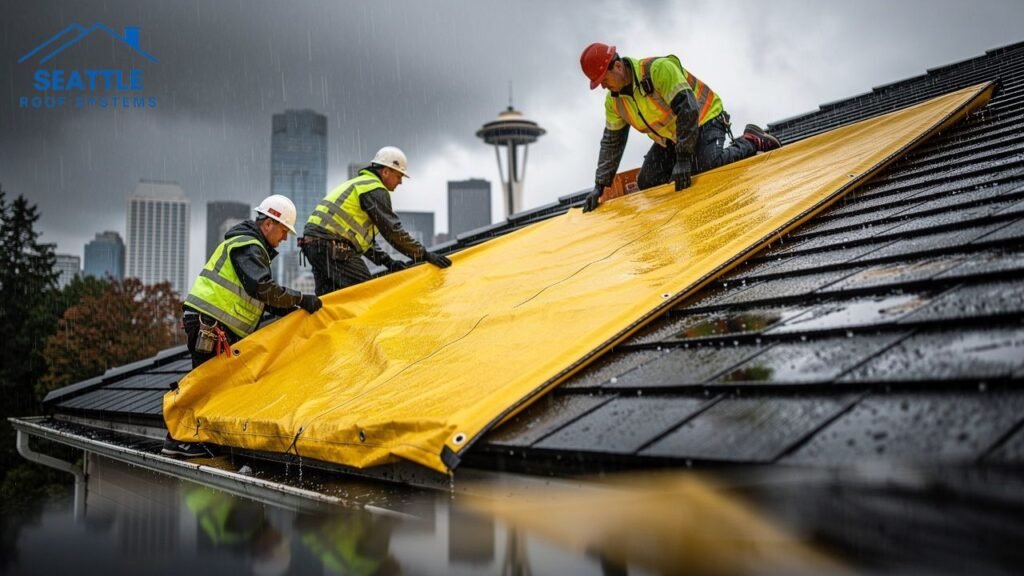
How Emergency Roof Tarping Actually Works
The process starts with a safety assessment because putting someone on a compromised roof kills the benefit of having a safe solution.
We had this job in Ballard where wind damage had partially lifted the roof structure itself. Getting anyone up there was dangerous. So we used ground rigging instead, installing the tarp from below with poles and anchors that hold it above the roof line without adding pressure to the compromised section. This is how emergency roof tarping works.
We secure heavy duty material across the damaged area plus a generous perimeter around it by ensuring water sheds away from your house instead of running toward it.
It takes time but prevents the emergency tarp from becoming the problem itself. The average installation takes three to four hours when we are doing it properly.
How Long Can a Roof Tarp Stay in Place | The Realistic Timeline
Standard heavy duty tarps handle three to four months reliably in Seattle’s coastal weather pattern. Premium reinforced tarps stretch that to four to six months. Anything longer and material degradation starts winning against your protection. The limiting factor is not the tarp itself though. It is how long your permanent repair timeline actually is.
A tarp that gets monthly maintenance lasts the full expected timeline. A tarp that sits untouched degrades much faster. One job we had, the owner skipped inspections entirely. By month three, fastener corrosion had compromised half the edge fastening. We caught it during a routine visit, but another month of neglect and that tarp would have failed completely.
Signs You Need Emergency Roof Tarping
Visible holes and missing shingles in sections or daylight through your attic all require immediate tarping. These are the obvious ones but damage usually hides.
Look for lifted shingles where wind peeled them back, damaged flashing around chimneys and vents, or dents where debris hit hard enough to crack the weatherproofing layer underneath these all are signs you need emergency roof tarping.
Temporary roof protection after storm damage is not about obvious holes. It is about stopping the water that finds its way through damage you cannot see from below. That is why professional inspection after storms matters. That is why calling isn’t overreacting.
Tarp Types Compared | What Material Actually Makes Sense
| Tarp Material | What It Actually Is | Best Used When | Realistic Duration | Cost Range in Seattle |
|---|---|---|---|---|
| Standard Poly | Basic thick plastic, single layer | You need something fast and cheap | 2-4 months before degrading | $800-1,200 |
| Heavy-Duty Poly | Thicker material with reinforced stress points | Standard emergency jobs, moderate timelines | 4-6 months with monthly maintenance | $1,200-1,800 |
| Mesh Tarps | Woven polypropylene that breathes | You need ventilation and condensation prevention | 4-6 months, better moisture management | $1,500-2,000 |
| Reinforced Edge Tarps | Heavy poly with reinforced border strips | High wind exposure, longer wait times | 6-9 months in Seattle weather pattern | $1,800-2,500 |
| Insulated/Reflective | Poly with reflective backing and foam layer | Winter installations, heat loss prevention | 6-12 months but expensive solution | $2,200-3,500 |
We usually recommend reinforced edge tarps for Seattle jobs because our weather pattern punishes temporary materials. One big storm and clearing? That’s manageable. Constant rain cycling, wind between systems, temperature swings? That’s what kills basic tarps. We’re managing uncertainty, not a single event.
When to Tarp a Roof After Storm Damage
Call within 24 hours of discovering damage ideally the same day before nightfall. If you notice roof damage at 3 PM Thursday, you’re calling by Friday morning at the latest, or you’re gambling with weather that might roll in Thursday night. Waiting for Monday because it’s the weekend always backfires in Seattle because rain doesn’t respect business hours or your schedule.
Your insurance might push back on emergency tarping costs because they’re looking at the invoice and the roof tarping cost. Then three weeks later when secondary damage shows up, they’re paying tens of thousands extra. Quick decision beats perfect decision when water’s involved.
Why DIY Tarping Always Ends Worse Than Calling Us
You save $1000 on professional tarping and spend $8000 fixing water damage from the DIY tarp that failed. I have seen this calculation work out the same way a hundred times and it never works in the homeowner’s favor. The mistakes are predictable which actually makes this easy to explain.
When wind got underneath then lifted the whole tarp and water poured in during the storm. In that way, how emergency roof tarping works requires understanding pressure dynamics, wind load distribution and positioning for water shed patterns. That is not intuitive knowledge.
The Seattle Weather Reality for Long Term Tarping
Our coastal rain pattern is actually easier on tarps than the extreme heat that breaks them down in eastern Washington. But constant moisture exposure creates different problems. Your tarp never fully dries between rain systems. The material never gets a break from the moisture stress. Fasteners experience constant movement from wind gusts instead of occasional big events.
Monthly inspections catch this early. We clean edges and verify no mold is establishing on the material; we check that moisture isn’t undermining fasteners through corrosion. This maintenance is why our tarps last their full expected timeline. Neglected tarps fail early every single time.
What to Do After Storm Damage to a Roof
Call your insurance company right now before anything else. Document damage with photos from the ground and from inside your attic. Your insurance company needs to know within a specific timeframe or you might void coverage. This is step one and people skip it constantly to their regret.
The second call is to an emergency roofer for a tarping assessment. We come out same day if we can, we look at what’s happening, we explain what needs immediate action versus what can wait. Some damage requires a tarp today. Some situations can wait 24 hours if the weather’s totally clear.
What Actually Happens If Your Roof Tarp Starts Failing
Small tears grow because material flexes with temperature changes and wind stress. A quarter-inch puncture becomes a foot-long rip within weeks. Sagging sections where water’s pooling mean fasteners are loosening. Flapping edges mean wind is getting underneath. These are not theoretical problems. We see them every single month in Seattle’s weather pattern.
Water dripping inside your home despite the tarp being installed usually means either the tarp got repositioned by wind so it’s no longer covering the damaged section, or water’s running back under the tarp because of how edges are configured. Both need contractor attention.
Ignoring them hoping they improve just means more damage accumulates. Call immediately when this starts happening.
Contact Seattle Roof Systems Today
Seattle Roof Systems handles emergency roof tarp service in Seattle WA throughout the city and surrounding areas, and we have done this often enough to know exactly what needs to happen and how fast.
Tell us when the damage happened. We will get a crew moving. If it is after hours and it is truly emergency level and we have teams ready. We will assess and we will protect your home while everything else gets sorted.
Call (425) 996 1386 for emergency tarping now. We know how to make this less stressful when you are already stressed about your roof. You can also email us to schedule your assistance regarding when do you need emergency roof tarping at zoom@seattleroofsystems.com.
FAQ
What should I do right now if I see water coming into my attic?
Stop and call your insurance company first. Document everything with photos before touching anything. Then call an emergency roofer for same-day assessment. This isn’t something that improves with waiting. Water damage accelerates in Seattle’s climate, especially during our wet season.
Can I install a tarp myself using a hardware store tarp?
Technically yes. Practically, you’ll cause more damage than prevention. Hardware store tarps fail on roofs because they’re not anchored properly and positioning matters for water shed direction. The $900 you save becomes $8,000 in water damage cleanup bills.
How much does emergency roof tarping Seattle WA actually cost?
Pricing typically ranges from $800 to $2,500 depending on roof size, damage location, roof access difficulty, and tarp material type. After-hours emergency response costs more than daytime appointments. Most insurance policies cover emergency tarping as necessary water damage mitigation.
Will my homeowner’s insurance cover emergency roof tarping?
Yes. Most policies cover emergency roof tarping as required damage mitigation. It’s not optional. Insurance companies understand that tarping prevents larger claims. Call your adjuster immediately to confirm coverage before committing to installation.
What happens if the tarp fails before permanent repairs finish?
Call us immediately. We handle maintenance and repairs during the installation period. Replacement or repair usually happens within 24 hours. A failed protective barrier is too critical to delay fixing.
How long will a tarp stay on my roof?
Depends on your permanent repair timeline. Could be three weeks if everything coordinates perfectly. Could be four months if structural damage requires engineered solutions or materials are backordered. We maintain tarps as long as needed.
Does tarping cause damage to my roof underneath?
No. Professional tarping doesn’t damage the roof structure. Fasteners are designed not to compromise decking. The tarp protects what’s left while permanent repairs get scheduled and completed.
Can I delay tarping if weather looks clear for a few days?
Not really. Seattle’s weather changes fast. A clear morning becomes rainy afternoon. The risk isn’t worth the savings. Get the tarp up within 24 hours of discovering damage.
Do you handle roof tarping throughout Seattle neighborhoods?
We cover Seattle and surrounding communities including Ballard, Queen Anne, Green Lake, Fremont, Wallingford, and beyond. Call us with your address and we’ll confirm coverage. Most of greater Seattle is our service area.
Why does emergency roof tarping take longer in Seattle than other cities?
Our weather pattern is relentless. Constant rain cycling means tarps experience ongoing moisture and wind stress. We use heavier-duty materials and more frequent maintenance to combat that. It costs more upfront but prevents tarp failure from our weather beating it down.
What’s the typical wait time for emergency tarping in Seattle?
During storm season (fall and spring), crews fill up fast. Call immediately after discovering damage. We often handle same-day emergency appointments, but if you wait, you might be waiting days. After hours emergency response is available but costs premium pricing.
Sources
1. Federal Emergency Management Agency: Federal data shows rapid protective measures reduce secondary damage and recovery costs by 55% to 70% when implemented within 24 hours of damage discovery. This guidance applies directly to residential properties.
2. The National Center for Disaster Preparedness Studies document that protective measures deployed within 24 hours prevent average additional damage costs of $8,200 compared to interventions delayed beyond 48 hours.