Summarize with
The cost of roof drain unclogging is approximately $200. The same drain after two winters on a 30,000 square foot warehouse is closer to $50,000: soaking insulation, rotting decking, membrane (which you must tear off), and whatever was destroyed by the water in the warehouses below.
Owners learn this the hard way, over and over. Roughly 80% of commercial roofing systems get torn off before they should, and the cause is rarely one dramatic failure.
The National Roofing Contractors Association (NRCA) provides industry data showing how proactive maintenance and regular inspections can extend roof performance and reduce avoidable repair costs.
This commercial roofing inspection guide covers what you’ll pay in 2026, why two bids on the same building can differ by $1,200, and when a free inspection is actually worth taking.
Key Components of Commercial Roof Assessment
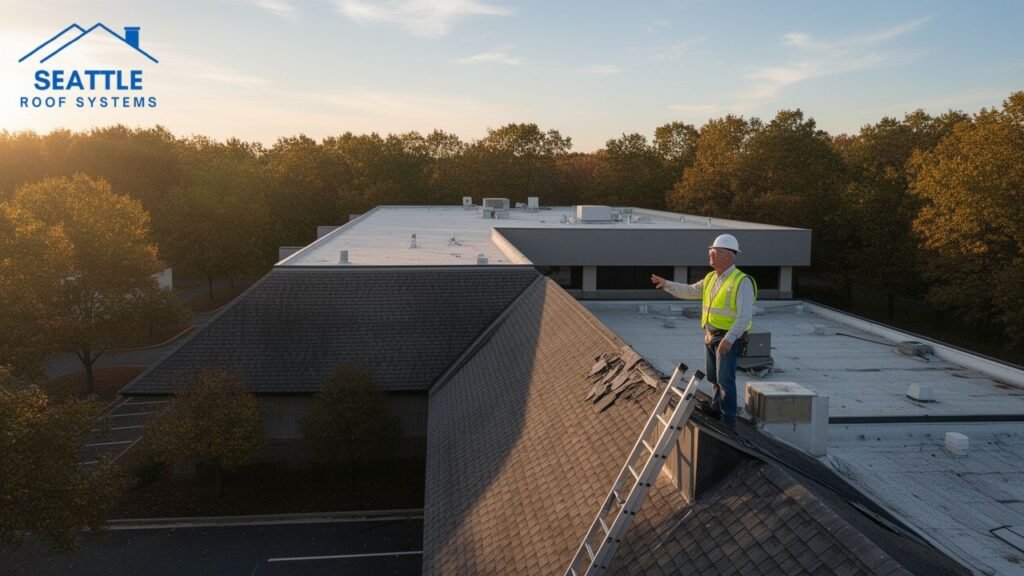
An extensive commercial roof assessment is not someone squinting at your roof from the parking lot. The inspector inspects the entire surface, looking for blisters, punctures, and lifted seams on a membrane system, and all flashing details: HVAC curbs, pipe boots, skylights, parapet walls. That’s where most leaks begin, not out in the open field of the roof.
Drainage gets a hard look. Ponding water is the most destructive thing that happens to flat commercial roofing systems, and the easiest to ignore, because it doesn’t look like damage. It looks like a puddle. Half an inch of standing water weighs about 2.6 pounds per square foot and turns into a mold farm by August.
Inside, the inspector checks ceilings for staining and decking for soft spots where accessible. You should walk away with a written report, photos, a remaining service life estimate, and repairs ranked by urgency. Thermal imaging and core sampling are add ons that push the price up, and they’re frequently worth it on a roof over twelve years old.
Energy performance factors, including reflective roofing materials and cool roof considerations, are also addressed in commercial roof planning resources from the U.S. Department of Energy.
Average Commercial Roof Inspection Cost by Building Size
Square footage is the biggest lever on price.
Under 5,000 sq. ft.: $200 to $400. Strip retail, a single dental office, a standalone restaurant. Most are done in ninety minutes.
5,000 to 20,000 sq. ft.: $400 to $800. Mid size warehouses and clinics, with more rooftop equipment to work around.
20,000 sq. ft. and up: $800 to $2,000+. Big box and industrial buildings, where many commercial roofing contractors switch to per square foot pricing, between $0.05 and $0.25.
The average commercial roof inspection cost across all building types lands near $500. That’s a decent benchmark, but not much use for budgeting on its own, since a 4,000 square foot bakery and a 90,000 square foot warehouse are both technically “commercial.”
Many contractors will inspect for free when bidding repair work, and those are worth taking, but a twenty minute walk from someone trying to sell you a new roof isn’t the same as a paid condition report.
Factors Affecting Roof Inspection Cost
Two contractors can quote the same building and land $1,200 apart, which is common in commercial roofing since scope varies from contractor to contractor. Here are the factors affecting roof inspection cost most often.
Roof type: Single ply membrane (TPO, EPDM, PVC) sits at the low end because the surface walks easily and problems are visible. Metal and built up commercial roofing costs more to inspect, for reasons covered below.
Access and height: A single story with a roof hatch is easy. Four stories with one ladder point means rigging fall protection before anyone steps out, and you pay for that time.
What’s on the roof: HVAC units, exhaust fans, solar arrays. Every one is an obstacle and a penetration point that needs its own look. A clean deck inspects fast. A roof that looks like a mechanical yard does not.
Method: Visual is cheapest. Drone work adds $500 to $1,500 on commercial properties. Infrared adds $400 to $600 on top of a base fee, which sounds steep until it finds 4,000 square feet of wet insulation you were about to roof straight over.
Flat Roof Inspection Cost vs. Metal Roof Inspection Cost
A flat roof inspection cost on single ply membrane stays low because the surface is walkable and most problems show themselves. The metal roof inspection cost usually runs higher, since someone has to check thousands of fasteners, every panel seam, corrosion at the eaves, and whatever’s left of the coating.
Built up roofing is its own problem: four or five layers, and you can’t see what the bottom ones are doing without cutting into them.
On a panel building, drone photos of every seam can shave real time off a manual walk, which is one reason drone assisted inspections sometimes come in cheaper than a full day of foot traffic on a large commercial roofing project.
Commercial Roof Inspection Pricing by Inspection Type
Visual walk through, $250 to $500. Someone with twenty years of experience walks your roof and puts hands on the flashings. This is the standard commercial roofing maintenance inspection, and it’s what most buildings need twice a year. Not glamorous. Catches most of what matters.
Drone, $500 to $1,500. A pilot flies a programmed grid and returns with 200 to 400 overlapping images on a 10,000 square foot roof, which can reduce inspection time compared with a full manual walkthrough. Insurers now accept drone documentation on claims, which they were reluctant to do five years ago. The weak spot: a drone can photograph a soft deck, but it can’t feel one.
Infrared, $400 to $600 as an add on or $1,000 to $2,500 standalone. A radiometric sensor reads temperature differentials after sundown and shows exactly where water sits inside the assembly. Both push the commercial roof inspection pricing up, and both are worth it on an older commercial roofing system.
Full condition report, $800 to $2,500+. Photo documentation, a written condition summary, remaining useful life, and capital planning numbers. If you’re doing due diligence on an acquisition or defending a capex request to a board, this is the version that survives scrutiny.
Benefits of Commercial Roof Inspections
NRCA data puts a maintained commercial roof at roughly 21 years of service and a neglected one at about 13. Eight years.
Run that against real replacement numbers. A 10,000 square foot commercial roofing system in 2026 costs $75,000 to $140,000 for standard TPO or EPDM. Two inspections a year at $500 each is $1,000 annually, or $12,000 across twelve years. Buying eight extra years of roof life for $12,000 isn’t a close call.
NRCA also found proactive maintenance cuts repair costs by up to 50%, with about $4 returned for every $1 spent, and that up to 40% of building problems start with water coming through the roof. Carriers want maintenance documentation after hail or heavy snow too, and “we’ve never had it inspected” is a sentence adjusters have used to deny otherwise legitimate claims.
Roof Inspection Cost for Commercial Buildings by Region
Roof inspection cost for commercial buildings swings by geography, and not just because of weather. Labor rates, code requirements, and storm frequency all move commercial roofing prices from one region to the next.
A typical visual inspection in Texas will cost $250 to $600; however, in larger buildings in Dallas, Houston, and Austin, it will run up to $800 to $1,000, and more after a poor hail season. California runs above the national average on labor and code, with the Bay Area landing between $300 and $1,800 relying on scope, while Sacramento and Southern California sit lower, generally $300 to $800.
Higher wages, older buildings, and snow load concerns often push Northeast inspection prices above the national average. In cities such as New York, Boston, and Philadelphia, costs may run 15% to 25% higher depending on the building and inspection scope. Midwest prices are in the $250 to $600 range, with the coasts, which are exposed to hurricanes, 20 to 40% more.
Commercial Roofing Maintenance Inspection Guidelines
Once a roof reaches 15 years of age, consider quarterly inspections if the building conditions justify the added frequency, and do the same if the roof gets regular foot traffic from HVAC techs, since service crews damage more membrane than weather does and nobody reports it.
There’s a contractual reason too. Most commercial roofing warranties require documented maintenance, and manufacturers do check. Skip your inspections for three years, and the warranty you paid extra for may not be worth much when you need it.
Roof Inspector Qualifications
Not every roofing contractor with a ladder qualifies for commercial roofing work. Check for current licensing, real insurance, and fall protection training and experience in buildings similar to yours.
Regional knowledge matters more than people think: someone who understands freeze thaw behavior in Minnesota or uplift requirements in Miami Dade writes a better report.
Quotes can get surprisingly different, especially if you’re getting quotes for drone flights, infrared scans, and a written report, so you need to get this in writing first. Ask for references on buildings like yours.
A mediocre commercial roofing contractor may work great doing warehouses all day, but not very well on a shared office roofing contract with 6 leases and a shared roof. Seattle Roof Systems focuses on providing detailed commercial roof assessments where the inspection report is only as good as the person who writes it.
Frequently Asked Questions
Can I get a free inspection?
Often, yes. Many commercial roofing contractors inspect free when quoting repair work. Just recognize the incentive: a company that profits from replacement isn’t a neutral party on whether you need one. For anything going into a budget or a lawsuit, pay for an independent report.
Does insurance cover routine inspections?
No. If yours is part of a storm damage claim, the carrier sends its own inspector at no cost, though that person works for them. Some commercial property policies require documented annual inspections as a condition of coverage, so read yours.
How long does an inspection take?
Two to four hours for most buildings. A small retail roof can be done in ninety minutes. A 50,000 square foot facility with thirty rooftop units, especially with thermal imaging, can take the whole day.
Is the cheapest quote a good idea?
Not automatically. If you are not flashing details or making drainage checks, you’re spending more money when you miss something.
A mid size building will cost about $1,000 for two inspections per year. One phone call will get you a solid quote, and before you can decide which line item you want to have in next year’s budget, you should compare the replacement number for your square footage.
Sources
- National Roofing Contractors Association (NRCA) – Referenced for commercial roof service life comparisons, maintenance impact data, repair cost reduction statistics, and water infiltration information.
- U.S. Department of Energy – Referenced for commercial roof energy performance information and cool roof specifications related to building efficiency.
- National Institute for Occupational Safety and Health (NIOSH): Referenced for research and safety recommendations related to preventing fall hazards during roofing work and inspections.