Summarize with
It usually starts small for roof leak repair Seattle, WA. A brown ring on the bedroom ceiling that wasn’t there in September. A drip you can hear before you can find it. A damp patch above the window that shows up after four straight days of rain and then dries just enough that you decide it can wait until spring.
What surprises most people is what to do when you discover a roof leak in dramatic weather. We average about five days a year with more than an inch of rain. What we get instead is roughly 150 days of drizzle and about 39 inches spread thin across eight months, so a roof here basically never dries all the way out between October and May. A gap that would sit harmlessly on a house in Phoenix stays damp in Ballard for most of the year. Damp is what rots sheathing.
Most of the calls we take in November start the same way. Somebody noticed something in early October and hoped it would sort itself out.
The first hour is about your house, not your roof
Move the furniture. Pull up the rug. Water in drywall runs sideways along the ceiling joists, so the wet patch you can see is always smaller than the one you can’t.
Put down a bucket with an old towel in the bottom of it. Sounds fussy. It kills the splatter and the drip noise, and you’re going to want to sleep tonight.
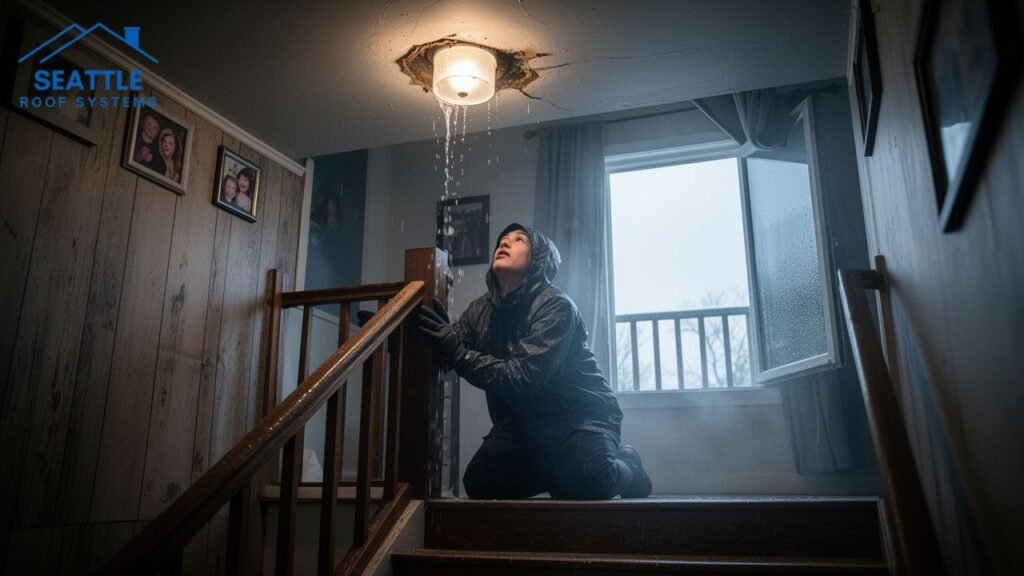
Now the part nobody likes doing. If the ceiling is sagging, or there’s a bulge in the paint, poke a small hole at the lowest point of it with a screwdriver and set the bucket underneath. Everybody hesitates here, because you are deliberately damaging your own ceiling on purpose. Do it anyway. That bulge is a pocket of trapped water, and a small hole you can patch for forty bucks beats the whole ceiling letting go at two in the morning.
If there’s water anywhere near a light fixture, a ceiling fan, or a smoke detector, shut off the breaker for that room before you start mopping.
Then photograph everything before you clean up. Wide shots, close shots, the soaked insulation, the stained rafter, the bucket. Ten minutes of that is worth more than any phone call you’ll have with an adjuster three weeks later.
Please stay off the roof
This isn’t a liability line. It’s the single most Seattle specific piece of advice in this article.
Our roofs grow moss. North-facing slopes, anything shaded by a big leaf maple or a stand of firs, they all end up with a soft green layer that holds water like a sponge from October onward. Wet moss on asphalt shingle is slippery in a way people are not prepared for. Closer to algae on a boat ramp than to a damp sidewalk.
Every winter, people get badly hurt going up to look for a leak in the rain. And there’s a second, quieter problem: walking on cold, saturated shingles cracks them. We’ve been called out to fix one leak and found three new ones directly under a homeowner’s boot prints.
Go into the attic instead. A flashlight and twenty minutes up there will tell you more than an hour on the roof would, and you won’t fall off your attic.
The stain is not the leak
This one catches almost everybody. Water gets in through the roof, runs down the underside of the sheathing, tracks sideways along a rafter, hits a nail or a seam, and only then drops onto your ceiling. The actual entry point can be eight or ten feet uphill from the stain in your bedroom.
Up in the attic, look for dark trails running down the wood, rusted nail shanks, matted or discolored insulation, and any spot where you can see daylight. Follow the trail up the slope. Where it stops is usually where the water is getting in.
What’s usually causing it
The rubber boot around a plumbing vent pipe is the most common single culprit we find, and it isn’t close. Those collars dry out and split somewhere around year twelve, which is often years before the shingles themselves are worn out. Cheap to fix. Constantly ignored, because the roof “looks fine” from the driveway.
After that it’s flashing. Chimneys, dormers, anywhere the roof meets a wall. Old flashing, badly sealed flashing, or flashing that somebody reused during a re-roof in 1998 to save eighty dollars.
Valleys come next, and this is a Pacific Northwest specialty. Fir needles and maple leaves pack into the valley, form a little dam, and shove water sideways under the shingles instead of down into the gutter.
Skylights leak far more often at the seals and around the curb than through the glass. We could write a separate article about skylights, and probably will.
And moss again, which lifts shingle edges as it grows and wicks water backward up the slope, against gravity, which feels unfair but is exactly what it does.
Sometimes it isn’t a leak at all
Worth ruling out before you call anybody, including us.
A real number of “leaks” in older Seattle homes turn out to be attic condensation, usually from a bathroom fan that vents into the attic instead of out through the roof. It’s common in houses around Wallingford, Green Lake, and Phinney Ridge that have been remodeled two or three times since the forties, each remodel taking a slightly different shortcut.
The tell is the pattern. A real leak is localized, shows up during or just after rain, and traces back to one entry point. Condensation is spread out, worst on the coldest sheathing near the eaves, and it shows up on clear cold nights when it hasn’t rained at all.
Different problem, different fix. You don’t want to pay for roof repairs that were never going to solve it.
When it’s an emergency and when it isn’t
Call the same day if water is actively running during rain, if it’s anywhere near electrical, if the ceiling is sagging, or if wind has stripped shingles and left bare decking exposed. Those get worse by the hour, not by the week.
A slow stain that only appears during a heavy stretch can wait a few days. It should not wait a season.
One honest note about emergency roofing Services Seattle. At nine at night in a windstorm, the job is to stop water: tarping, temporary sealing, sometimes just redirecting flow away from an exposed area. The permanent leaking roof repair happens once there’s a dry enough window, which in December can mean waiting two or three days for the weather to cooperate. Any crew promising a full permanent fix in the middle of a storm is either overselling or planning to do it badly.
Your insurance, briefly
Short version: sudden and accidental damage is usually covered, and wear usually isn’t. A branch through the roof during a windstorm, or shingles torn off in a November atmospheric river, is normally treated as rain damage roof repair under a standard policy. A twenty-two year old roof that finally gave up, or one that failed under six winters of untreated moss, normally isn’t.
Two things genuinely change the outcome. Document from day one, receipts for tarps and temporary work included. And don’t sit on it, because most policies require you to take reasonable steps to prevent further damage, and a claim filed six weeks after you first saw the stain hands the insurer an easy reason to reduce it.
Worth knowing your side of the deal too. The Washington State Office of the Insurance Commissioner has a plain-English rundown on filing a homeowner insurance claim, including the fact that your insurer has 30 days from the date you file to inspect the damage, and that you get to choose your own contractor rather than taking whoever is on their preferred list.
Keeping the next one from happening
Clear the gutters twice a year here, not once. Late fall after the maples finish dropping, and again in spring once the firs have shed. Clogged gutters back water up under the bottom course of shingles, and that’s a leak that starts at the very edge of the roof where nobody thinks to look.
Deal with moss before it gets thick. Zinc or copper strips near the ridge slow regrowth, and a proper treatment kills what’s already there.
Do not pressure wash an asphalt roof. Please. It strips the granules off and takes years off the roof’s life, and more than once we’ve watched a homeowner turn a healthy fifteen year old roof into a replacement job in a single Saturday afternoon.
Cut back branches that hang over the roof. Less debris, less shade, less moss.
Then get eyes on it once a year, ideally in September before the rain properly settles in.
Repair it or replace it
If you’re on your third repair to the same slope, if the gutters are full of granules that look like coarse black sand, or if the roof is past twenty years, price a replacement alongside the repair before you decide.
Sometimes patching is genuinely the right call for emergency roof leak repair Seattle and we’ll tell you so. Sometimes it’s just paying for the same problem twice.
FAQs about roof leaks in Seattle
Can a roof be repaired while it’s raining?
A temporary fix, yes. Tarping and emergency sealing both work in wet conditions. A permanent repair mostly doesn’t, because sealants and adhesives need a dry surface to bond and shingles need to lie flat and warm slightly to seal. In winter we often tarp first and come back within a few days.
How long can I leave a small leak before it becomes a problem?
In this climate, less time than you’d think. Sheathing that stays wet can start to soften within a few weeks, and wet insulation stops insulating almost immediately, so your heating bill notices before your ceiling does. Mold gets going in damp cavities in a matter of days.
Why does my roof only leak during heavy wind?
Usually wind-driven rain being pushed sideways under shingles or into a flashing gap that sheds water fine in ordinary rain. It points to flashing, ridge caps, or lifted shingle edges rather than a hole. It’s also one of the harder leaks to trace, because it won’t reproduce on a calm wet day.
Should I remove the moss myself?
You can, carefully, with a soft brush and a dry-ish stretch of weather, always brushing downward with the shingle overlap. Never a pressure washer, never a metal scraper, never uphill. If the roof is steep, wet, or two stories up, it’s not worth the ladder.
What does roof leak repair in Seattle cost?
It depends entirely on the cause. A cracked pipe boot is one of the cheapest repairs in roofing. Reflashing a chimney costs considerably more, and anything involving rotted decking means the price moves with how far the rot has spread, which nobody can quote accurately from a photo. Any roofer giving you a firm number over the phone without seeing it is guessing.
How do I know a roofing contractor is legitimate?
Check them before you sign anything. Washington requires contractors to be registered, bonded, and insured, and the state runs a free lookup where you can verify a contractor’s registration, bond, and complaint history in about two minutes. Do it even in an emergency, and especially in an emergency, because storm chasers show up in Seattle neighborhoods after every big windstorm.
Talk to someone who’s actually seen it
Seattle Roof Systems handles repairs for roof leaks in Seattle, from same-day tarping and emergency calls through full replacements.
If you’ve got a stain on the ceiling and you’re not sure whether it’s urgent, call and describe it to us at (425) 996-1386. We’ll tell you straight whether it needs a truck tonight or an appointment next week. We’d rather talk you out of an emergency call than sell you one.