Summarize with
A commercial roof that gets professionally looked at twice a year lasts around 21 years. One that only gets attention after water hits somebody’s desk lasts about 13. That eight year gap, documented by the National Roofing Contractors Association, is the entire financial case for a scheduled commercial roofing service, and it lands on a balance sheet long before it shows up on a ceiling tile.
The commercial roof inspection schedule
The NRCA baseline is two professional inspections per year, ideally spring and fall. Spring catches what winter did. Fall catches what needs fixing before the wet season arrives.
That baseline is a floor, not a target. Several conditions push a building above it. Membranes past year 15 shift toward quarterly. So do roofs with heavy rooftop equipment, and roofs where HVAC techs, telecom crews, and solar installers come and go regularly. A single uncoordinated curb cut around an HVAC unit is one of the most common causes of leaks near penetrations, and nobody files a report about it.
There’s also a start date most owners miss. NRCA recommends an inspection within 90 days of any new installation or significant repair, before the warranty clock has run long enough to hide an installation defect behind normal wear.
Building a commercial roof maintenance schedule
Age tiering is the practical way to set a commercial roof maintenance schedule without overspending on a newer roof or under inspecting an old one.
Years 1 through 10 on a properly installed TPO, EPDM, or modified bitumen system usually run fine on semiannual visits. Years 10 to 15 is where seams start telling on themselves and where an annual commercial roof inspection stops being sufficient on its own. Past 15 years, quarterly makes sense, along with an infrared moisture scan every three to five years to find saturated insulation before it spreads. Wet insulation does not announce itself. It sits there gaining weight and losing R value while the membrane above it still looks fine from the hatch.
Cost sits in favor of the schedule. Understanding the commercial roof inspection cost helps building owners compare preventive maintenance against expensive emergency repairs. Preventive roof maintenance runs roughly $0.14 per square foot annually against about $0.25 for reactive work, and emergency repairs commonly run several times the cost of planned ones. On a 25,000 square foot roof, that spread is real money every single year.
Why Seattle rewrites the calendar
National advice assumes a national climate. Seattle doesn’t have one.
Sea-Tac now averages 39.34 inches of precipitation a year under NOAA’s 1991 to 2020 normals, up from 37.49 inches in the previous period. Rain falls on roughly 150 days. Between 2011 and 2020 the city logged 68 days with over an inch of rain, up from 49 the decade before, and that is the largest ten year tally since records began in 1945.
Persistent moisture, not violent weather, is what wears Puget Sound roofs down. Two things follow from that.
First, moss and biological growth. Organic matter takes hold in shaded low spots, holds water against the membrane, then works its way into seams and clogs drains. Roofs on the north side of taller buildings and anything under a mature Douglas fir canopy need the growth cleared, not just noted.
Second, ponding. ARMA and NRCA both define ponding as water still sitting 48 hours after rain stops, under conditions that should allow drying. That 48 hour rule is a genuinely useful test you can apply yourself. In a climate where the next rain often arrives before the last one has dried, drains and overflow scuppers have to work perfectly, and a clogged scupper in November is a much bigger problem here than it is in Denver.
Roof inspection after storm damage
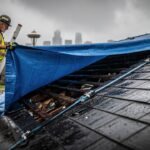
A roof inspection after storm damage is not the same visit as a scheduled one, and the timing matters more than most owners expect.
Atmospheric river events and Puget Sound convergence zone systems bring wind driven rain that pushes water sideways under flashing and up under counterflashing. Nothing on the surface looks torn. The leak shows up three weeks later, twenty feet from the actual breach.
Get on the roof within a week of any windstorm above about 45 mph, heavy wet snow, or a significant seismic event. Seattle sits near the Seattle Fault zone, and shaking loosens equipment curbs and edge metal in ways that only show up on inspection.
There’s an insurance angle here too. Carriers deny storm claims by attributing damage to gradual wear. Dated inspection reports with photographs establish the roof’s condition before the event, which is often the difference between a paid claim and a denied one. Insurers rarely accept “it was fine before the storm” without documentation.
Who should walk your roof
Sending a facilities tech up the hatch for a quick look feels efficient. In Washington it also carries liability that federal guidance doesn’t cover.
Washington’s Department of Labor and Industries enforces Chapter 296-880 WAC, which requires fall protection at four feet, stricter than federal OSHA’s six foot construction threshold under 1926.501. Skylights count as holes and need guarding. Fall protection has been OSHA’s most cited violation for fifteen straight years, with 5,914 citations issued in fiscal 2025 alone.
There’s a warranty argument as well. Most manufacturers require inspections by a credentialed contractor. A walkaround by your building engineer does not satisfy that clause, however thorough it was.
Your commercial roof inspection checklist
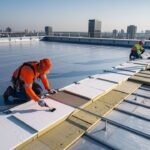
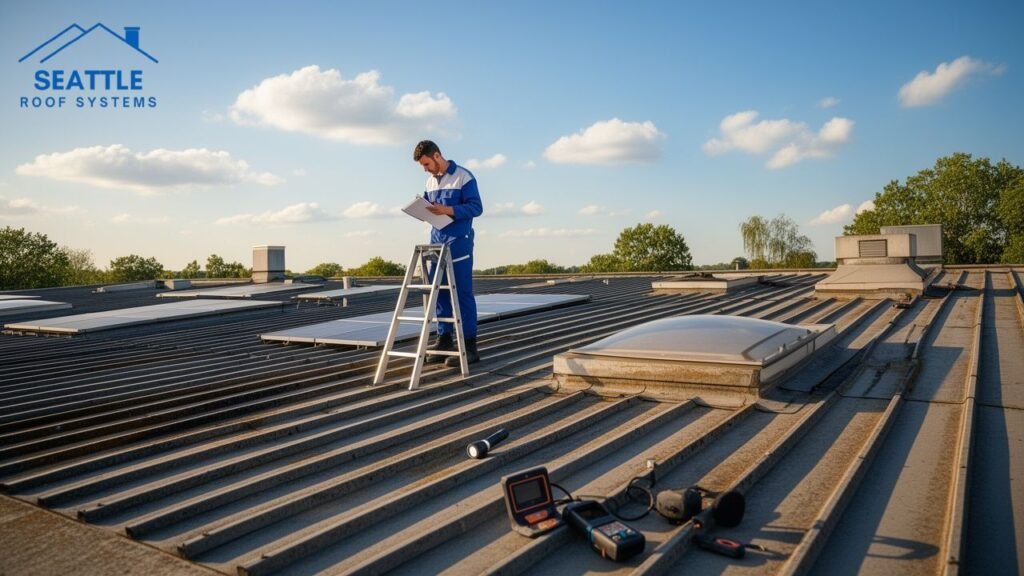
A serious commercial roof inspection checklist covers the full surface, not the area visible from the access point. What belongs on it:
- Field membrane, checked for punctures, blisters, and shrinkage, with seams probed rather than eyeballed
- Flashing at parapets, equipment curbs, and roof edges, where separation and lifting start
- All penetrations: HVAC curbs, vents, pipe boots, conduit, skylights
- Drains, scuppers, gutters, and downspouts cleared and tested for flow
- Ponding areas mapped against the 48 hour standard
- Moss, algae, and debris accumulation, especially in shaded zones
- Edge metal, coping, and counterflashing fasteners
- Interior deck and ceiling review for staining, sagging, or corrosion
- Photo documentation, dated, tied to specific locations on a roof plan
That last line does more work than it appears to. A written report with dated photos is what keeps a warranty enforceable and what an adjuster will ask for.
Signs a commercial roof needs inspection
Some signs a commercial roof needs inspection show up indoors well before anyone sees anything on the roof itself.
Watch for ceiling stains that appear and fade, a musty smell near exterior walls, and cooling or heating bills climbing without a rate change, which often points to waterlogged insulation. Bubbling or peeling paint at the top of interior walls counts. Outside, look for granules collecting at downspout outlets, visible sag in the roof plane, standing water two days after rain, and daylight visible at any deck penetration.
Tenant complaints are the underrated signal. When a retail tenant mentions a damp smell in the stockroom, that is usually the earliest warning anyone will get.
Preventive roof maintenance protects your warranty
Here is where a lot of money quietly evaporates. Nearly every manufacturer system and NDL warranty requires documented annual maintenance by a certified contractor. When a claim gets filed, the manufacturer pulls those records first.
Owners file claims eight years into a twenty year warranty and get denied because there are no records. The manufacturer’s position holds up: without maintenance documentation, they can’t separate normal wear from a covered defect. Reinstatement after a lapse is sometimes possible, typically running $500 to $2,500 depending on the manufacturer and roof size, and only after a full inspection and any required repairs.
Ponding beyond the warranty’s stated threshold, unauthorized penetrations, and repairs by non certified crews void coverage just as reliably. Preventive roof maintenance is what keeps all of that intact.
Commercial roofing maintenance tips worth using
A few practical commercial roofing maintenance tips that reduce cost between visits:
Keep a rooftop access log. Every trade that goes up gets recorded with a date and a reason. When a leak appears near a curb, you’ll know who was standing there.
Circulate a one line rule to your vendors: nobody cuts, drills, or anchors into the roof without calling the roofing contractor first. That single policy prevents more warranty problems than any other habit.
Clear drains before the wet season starts, not after the first backup. Keep the roof plan, warranty certificate, and every inspection report in the same file. And treat load limits as real, particularly if solar panels or new equipment are going up.
Get quotes on a commercial roofing service agreement rather than paying per visit. A structured program bundles the semiannual inspections, drain clearing, minor repairs done during the visit, and written documentation, which usually costs less than the same work purchased piecemeal.
Frequently asked questions
1. How often should commercial roofs in Seattle be inspected?
Twice a year at minimum, with fall inspections finished before October. Given roughly 150 rain days annually and heavy moss pressure, many Seattle buildings do better on a three visit schedule: spring, late summer, and a pre winter drain clearing.
2. Does Seattle’s rain mean I need more inspections than the national standard?
The frequency stays similar, but the priorities shift. Seattle roofs need more attention to drainage, moss removal, and ponding than roofs in dry climates, and less to hail and thermal shock. Persistent moisture is the local failure mode.
3. Are there Washington regulations governing who inspects my roof?
Yes. WAC 296-880 requires fall protection at four feet, which is stricter than the federal standard. Any contractor working on your Seattle building must comply, and untrained in house staff on the roof creates real liability exposure for the property owner.
4. Should I inspect after every storm?
Not every rain event. Schedule one after sustained winds above roughly 45 mph, heavy wet snow, hail, or a noticeable earthquake. Wind driven rain damages flashing without leaving visible surface damage.
5. What’s the difference between an inspection and a roof survey?
An inspection is a visual and hands on condition assessment producing a report and repair recommendations. A survey, often infrared or core sampling based, maps moisture inside the assembly and is typically used for capital planning or before a re roof decision.
Ready to get your roof on a schedule?
If your last documented inspection was more than a year ago, your warranty may already be at risk and you probably won’t find out until you file a claim. Seattle Roof Systems builds maintenance programs around your specific membrane, your building’s age, and the way Puget Sound weather actually behaves.
Call Seattle Roof Systems at (425) 996-1386 or email zoom@seattleroofsystems.com to book a condition assessment. We’ll walk the full roof, photograph what we find, and give you a written report you can hand to a manufacturer or an adjuster.
Sources
- Professional Roofing, National Roofing Contractors Association,
- Asphalt Roofing Manufacturers Association: Ponding Water Basics.
- Occupational Safety and Health Administration: Duty to have fall protection
- Washington State Department of Labor and Industries .
- National Institute of Building Sciences, Whole Building Design Guide, Building Envelope Design Guide