Skip to content
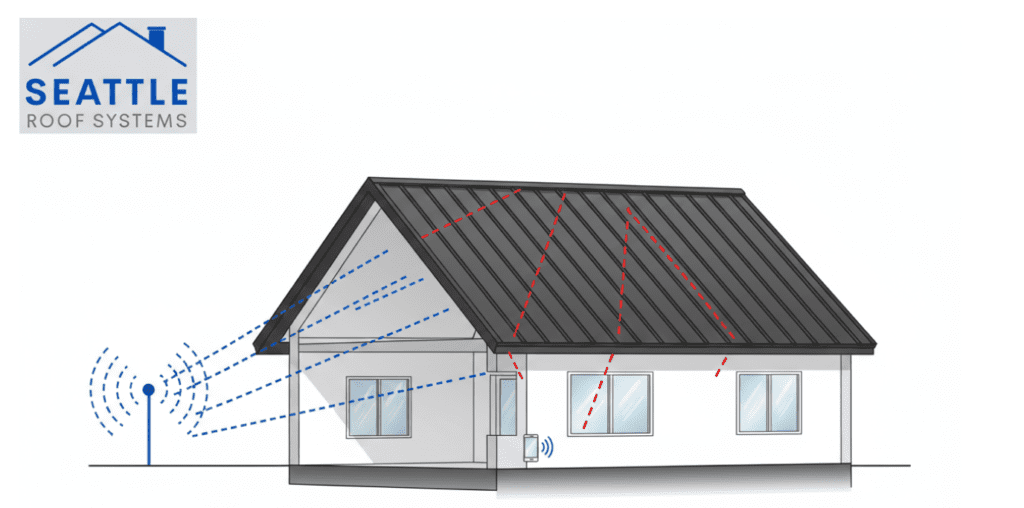
Metal roofs can interfere with cellular signals by reflecting or absorbing radio frequency waves. This material acts as a physical barrier that weakens the strength of the signal entering a building. While it is rare for a metal roof to cause a total loss of service, users typically experience a drop in signal bars. This effect is most noticeable in areas where the outside signal is already weak or when other building materials also block signals.
Providing clear and accurate information helps homeowners make informed decisions about their property. Seattle Roof Systems draws on extensive field experience to clarify how various roofing materials interact with modern communication technology. This guide details the physics of signal interference, the influence of surrounding geography, and the practical steps available to maintain reliable connectivity.
The Physics of Signal Blocking
Cellular phones communicate using radio frequency (RF) waves. These waves travel through the air and must penetrate the exterior shell of a building to reach a device. Metal is a highly conductive material, which means it interacts with these waves differently than wood or asphalt shingles. When RF waves hit a metal surface, the metal tends to reflect the energy rather than letting it pass through.
This phenomenon is sometimes compared to a Faraday cage. A Faraday cage is an enclosure made of conducting material that blocks external static and non-static electric fields, including the specific radio frequencies used for mobile communication. While a home with a metal roof is not a perfect Faraday cage because it has windows and doors, the large surface area of the roof still creates a significant shield. A report explaining why metal roofs can impact RF signals notes that metal is one of the most effective materials at obstructing RF signals, leading to measurable drops in indoor reception.
Measuring Signal Strength Loss
Signal strength is measured in decibels (dB). A perfect signal usually sits around -50 dB, while a total lack of service occurs at roughly -120 dB. Every building material causes some level of attenuation, which is the reduction in signal strength.
Common residential materials like drywall or clear glass only cause a minor reduction. However, metal and masonry are much more obstructive. According to research explaining how building materials block radio frequency signals, conductive materials can significantly limit RF signal penetration.
| Material | Typical Signal Loss (dB) |
|---|---|
| Drywall and Sheetrock | -2 dB |
| Clear Glass Windows | -4 dB |
| Poured Concrete | -10 to -20 dB |
| Brick | -12 to -15 dB |
| Metal Roofing | -32 to -50 dB |
This data shows that metal is significantly more obstructive than standard wood or brick. If a phone receives a moderate signal of -90 dB outside, a metal roof could potentially push that signal down to -122 dB inside, effectively cutting off service.
Other Factors Contributing to Poor Reception
It is rarely just the roof that causes dropped calls. Signal issues usually arise from a combination of factors. If a house is located several miles from the nearest cell tower, the signal is already weak by the time it reaches the property. In this scenario, the added interference from a metal roof becomes the breaking point for the connection.
Geographic features also play a massive role. Hills, mountains, and heavy foliage can block the line of sight between a device and the carrier tower. If a home sits in a valley, the signal might be skimming over the top of the house rather than hitting it directly. Weather conditions like heavy rain or thick fog can also temporarily degrade signal quality by scattering radio waves.
Internal Building Materials
Homeowners often blame the roof when internal materials are the true culprits. Many modern homes use foil-backed insulation in the attic or walls to improve energy efficiency. This thin layer of metal foil acts exactly like a metal roof, reflecting signals back outside. Similarly, Low-E glass windows contain a microscopic metallic layer designed to reflect heat. While great for energy bills, these windows also block cellular frequencies.
Bonus Tip: To identify the primary cause of signal loss, check the signal strength on a phone while standing in an open doorway. If the signal improves immediately, the walls or roof are likely the issue. If the signal remains poor, the problem is likely tower distance or local geography.
Technical Solutions for Indoor Signal Issues
If a metal roof is already installed or is the preferred choice for its longevity, several technical solutions can resolve reception problems. Modern technology allows for reliable indoor coverage regardless of the exterior construction.
Signal Boosters
A cellular signal booster is the most common fix. This system uses an external antenna, usually mounted on a chimney or the peak of the roof, to capture the strong signal from outside. A cable carries that signal into the house to an amplifier, which then rebroadcasts the signal through internal antennas. Because the external antenna sits above the metal roof, it bypasses the interference entirely.
Wi-Fi Calling
Most cellular providers now offer Wi-Fi calling as a standard feature. When enabled, the phone uses the home internet connection to route voice calls and text messages instead of relying on cellular towers. This is an effective and free solution for anyone with a stable high-speed internet connection. It eliminates the need for any additional hardware or installation.
Femtocells and Microcells
A femtocell is a small, low-power cellular base station that connects to a broadband internet router. It creates a localized “mini tower” inside the home. While these were very popular in previous years, many carriers are phasing them out in favor of Wi-Fi calling. However, they remain a useful option for areas with poor internet but specific carrier needs.
Things to Consider Before Making a Decision
Before choosing a roofing material, homeowners should evaluate their current cellular environment. If cell service is already spotty or weak outside the home, a metal roof will likely make indoor communication difficult without secondary equipment.
- Current Signal Strength: Use a smartphone to check the dBm (decibel-milliwatts) reading in different spots around the yard.
- Local Tower Proximity: Use apps or websites to locate the nearest towers for your specific carrier.
- Internal Insulation: Determine if the home uses foil-faced radiant barriers which could compound the signal loss.
- Window Type: Check if existing windows are Low-E or have metal security mesh.
- Internet Reliability: Ensure the home internet is stable enough to support Wi-Fi calling if cellular signals drop.
Bonus Tip: When installing a signal booster on a metal roof, ensure the external antenna is placed at least three feet above the metal surface to avoid signal “bounce” or feedback loops that can reduce the amplifier’s efficiency.
Common Questions About Metal Roofing and Signal Strength
Many people worry that a metal roof service will attract lightning or cause electronics to malfunction. There is no evidence that metal roofing increases the likelihood of a lightning strike. Furthermore, while the roof impacts radio waves, it does not affect the actual function of internal electronic devices like televisions or computers unless those devices rely on cellular data for their connection.
Another common concern is whether specific types of metal are worse than others. Generally, the thickness and the material (steel, aluminum, or copper) all provide similar levels of RF shielding. The most significant factor is the total surface area covered; a full metal roof will have a greater impact than a small metal porch accent.
FAQs About Metal Roofs and Cell Service
Does the type of metal affect the signal differently?
Most common roofing metals like steel and aluminum have similar conductive properties. They all reflect radio frequencies in a similar manner. The shape of the roof, such as standing seam or corrugated panels, does not significantly change how the signal is blocked.
Can a metal roof affect my Wi-Fi signal?
A metal roof generally does not affect Wi-Fi signals inside the house. Wi-Fi routers broadcast signals from within the building to your devices. The roof only becomes a factor if you are trying to use Wi-Fi in the yard or an unattached garage where the signal must pass through the metal exterior.
Is signal loss worse during storms?
While the metal roof itself does not change during a storm, water on the surface of the roof and in the air can further degrade signals. Rain and snow absorb radio frequency energy. If a signal is already weakened by the metal roof, the addition of heavy rain can lead to dropped calls.
Will a metal roof affect my GPS?
GPS signals are received from satellites high in the atmosphere. Like cellular signals, GPS waves can be blocked by metal. A smartphone might struggle to get a GPS lock while deep inside a house with a metal roof, though it will usually function correctly near windows.
Summary of Signal Impact
Metal roofing is a durable and energy-efficient choice for many homes, but its impact on cell service is a real technical consideration. While the material can reduce signal strength by 32 dB to 50 dB, this rarely results in a complete loss of communication for most users. Factors like tower distance, internal foil insulation, and geographic obstructions often play a larger role in connectivity issues than the roof itself.
For those living in areas with strong exterior signals, the change might be unnoticeable. For others, solutions like signal boosters and Wi-Fi calling provide easy ways to maintain clear reception. Seattle Roof Systems suggests that homeowners test their current signal strength and consider their connectivity needs before finalizing a roofing choice. Proper planning ensures that a home remains both well-protected and well-connected.
Contact Information
Seattle Roof Systems provides expert guidance on roofing materials and their performance in various environments. For more detailed information or to discuss specific roofing needs, contact the team directly at (425) 996-1386. You can also send detailed inquiries to zoom@seattleroofsystems.com to learn more about how metal systems interact with modern home technology.
Sources
- why metal roofs can impact RF signals – A technical guide explaining how metal surfaces obstruct cellular radio frequencies.
- how building materials block radio frequency signals – how building materials block radio frequency signals and the decibel loss caused by common construction materials.
- Pew Research Center – Statistics on mobile phone usage and dependency in the United States.